storebound

Open source · MIT · Bun CLI, MCP server, Agent Skills

Take your app or game from zero to “Submit for review” on Google Play and the App Store.

For mobile apps and games: app records, in-app products and subscriptions, listings in every language, every questionnaire, account deletion and review access, privacy, icons, screenshots and previews. One config and your AI coding agent. storebound never presses Submit.

bunx storebound init

Needs Bun (opens in a new tab) 1.1+ (and ffmpeg for icons, screenshots and video). Zero runtime dependencies. No account, no sign-up, no telemetry.

my-app
# one config, then dry runs first
$ bunx storebound check
$ bunx storebound apple bundle --dry
$ bunx storebound play listing --dry
$ bunx storebound play products --dry
$ bunx storebound apple iap --dry
$ bunx storebound apple subscriptions --dry
$ bunx storebound play data-safety --dry
$ bunx storebound apple appinfo --dry
$ bunx storebound icons --dry
$ bunx storebound shots render
$ bunx storebound validate
# what still blocks a submission,
# per store, in fix order
Submit for review · your click

The journey

Everything an app or game needs before review, in order.

For each step: what storebound does through the store APIs or on your machine, what a skill walks your agent through where the stores have no public API, and what stays your own click.

The journey: config, app records, products, listings, questionnaires, privacy and icons, store art, validate, then you press Submit. Each step is tagged API, UI, local or you.
  • API a storebound command (also an MCP tool)
  • LOCAL runs on your machine
  • UI a skill guides your agent, or you, through the console
  • YOU your own click

API or console, honestly

What it automates, what your agent walks through, what stays your click.

API

storebound does it

A CLI command, also an MCP tool. Every write has --dry.

  • Bundle id, builds on tracks, versions and build selection
  • Listings in every language, graphics, screenshots, app previews
  • In-app products with regional prices
  • Play Data safety (the whole form, from the config)
  • Apple age rating, categories, content rights, price and availability
  • Export compliance answer, App Review details
  • Phased release and staged rollout
  • TestFlight groups, testers, What to Test
  • Crash / ANR vitals, review replies, analytics, price CSV, product page tests
UI

Skill + your agent walk through

No public API. The skill has the exact navigation and prepared answers; an agent with browser tools clicks while you watch, or you use it as a checklist.

  • Creating the App Store Connect app record and the Play app
  • Play App content: IARC content rating, target audience, ads, advertising ID, app access, government / financial / health / news
  • Play category, tags and countries
  • App Privacy labels and their Publish
  • Adding the first IAPs to the submission
  • Play store listing experiments
YOU

Only you

Public, legal or money steps. The skills tell every agent to stop and hand these to you. None of them is an MCP tool.

  • Developer accounts, agreements, banking and tax
  • The answers to the questionnaires: they are your statements
  • Play: Send changes for review
  • App Store: Submit for Review
  • Releasing an approved version, resuming or completing a rollout or phased release
  • Beta App Review, tester invitations, sending review replies, applying price changes, starting a product page test

Apps and games

Not just for games. Pick a profile, start from honest templates.

init --profile app (the default: utility or productivity app, optional account, analytics, no ads), --profile subscription-app or --profile game. Each profile brings its own config, Data safety and App Privacy answers, declarations, listing and screenshot copy, all marked “edit to match your app”.

Both storesAPI

Subscriptions

Apple groups and levels, Play base plans, regional prices from one USD base, free trials, promotional offers and offer codes. Plan first, then your yes.

apple subscriptions · play subscriptions
Both storesAPI

One catalog, both stores

Consumables, non-consumables, non-renewing passes and subscriptions from one list. A parity report shows what is missing, mismatched or priced differently per region.

catalog diff
Both storesAPI

Review access

A demo account for the reviewer, kept only in .storebound/, sent to App Review masked; the Play App access answer prepared.

apple review-details
Both storeslocal

Account deletion

Apple 5.1.1(v) in-app deletion and Play's delete-account page: in the config, the review notes and the checks.

check · validate

Questionnaires

Every store form, prepared. The ones with an API, filled.

init gives you prepared answers (store/declarations.md, store/app-privacy.md), per profile: a utility app with an account, a subscription app, or a free-to-play game with ads and IAP. Change what does not match your app; the agent asks you whenever the code does not prove an answer.

Google PlayAPI

Data safety

The whole form from dataSafety in the config, imported as CSV through the API. The import replaces the form, so the config is the single truth.

play data-safety
Google PlayUI

IARC content rating

No public API. The store-declarations skill has the exact clicks and the prepared answers; your agent fills it in while you watch, or you copy them in.

store-declarations
Google PlayUI

Target audience and content

Walked through by the skill, together with ads, advertising ID, app access and the government, financial, health and news cards.

store-declarations
App StoreUI

App Privacy labels

From store/app-privacy.md, entered in App Store Connect, then Publish: saved labels that are not published are a classic blocker.

store-declarations
App StoreAPI

Age rating

The age rating declaration through the API, together with categories, content rights, Free price and availability.

apple appinfo
App StoreAPI

Export compliance

The answer comes from apple.usesNonExemptEncryption in your config, never guessed. When it is yes, the export-compliance skill covers the documentation.

apple encryption

validate cannot see the console-only forms, so the store-preflight skill lists them as a manual check before you submit.

Works with

Your AI coding agent. Or none.

Every route gives the agent the same skills and the same MCP tools. The skills are plain Markdown and the CLI is a normal command, so nothing here requires a particular tool.

  • Claude Code
  • OpenAI Codex
  • Cursor
  • GitHub Copilot
  • Gemini CLI
  • Windsurf
  • OpenCode
  • anything that reads AGENTS.md

Store art

Screenshots and previews, every size, every language.

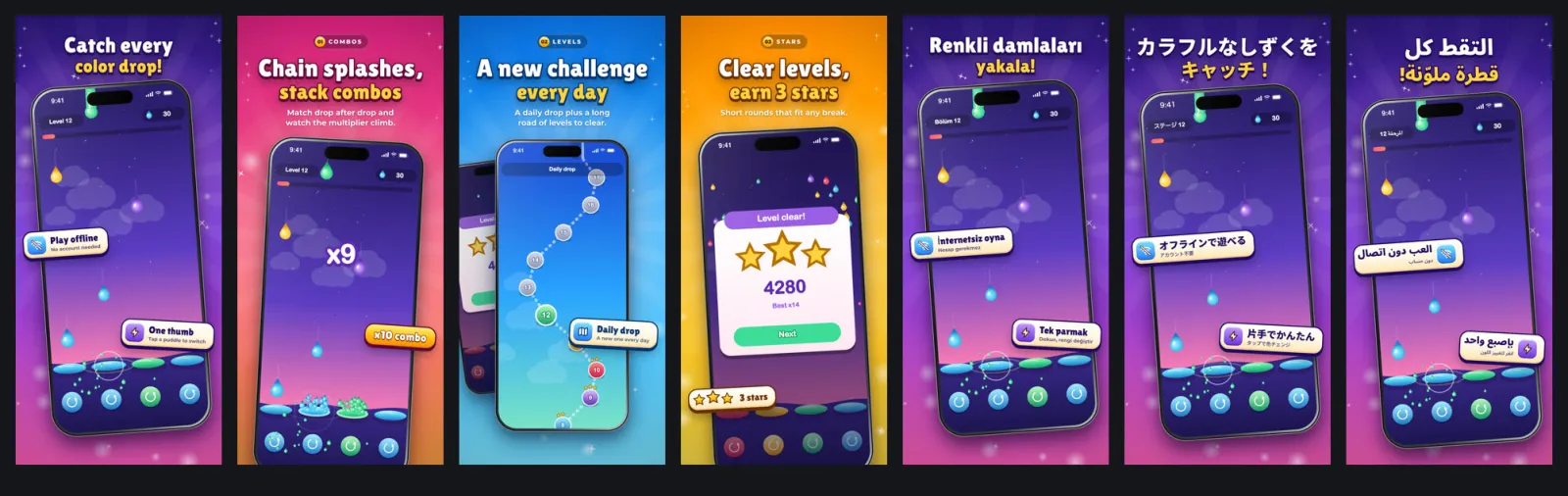
The step that takes longest by hand, in two looks: app (calm gradient, device frame, headline and subline) and game (sunburst, sparkles, badges). Everything below was made by storebound itself from two tiny fictional demos, a list app (“Tidy Lists”) and a game (“Prism Puddle”): raw frames from the web build, captions in 4 languages, every store size, a review gallery and an app preview video.

App style: four calm screenshots of a demo list app in two sizes and its feature graphic
App style: the demo list app, iPhone 6.9" and Play phone sizes, feature graphic.
Store screenshots rendered by storebound: four scenes in English plus the hero scene in Turkish, Japanese and Arabic
Game style: four scenes in English, the hero scene in Turkish, Japanese and Arabic (right to left).
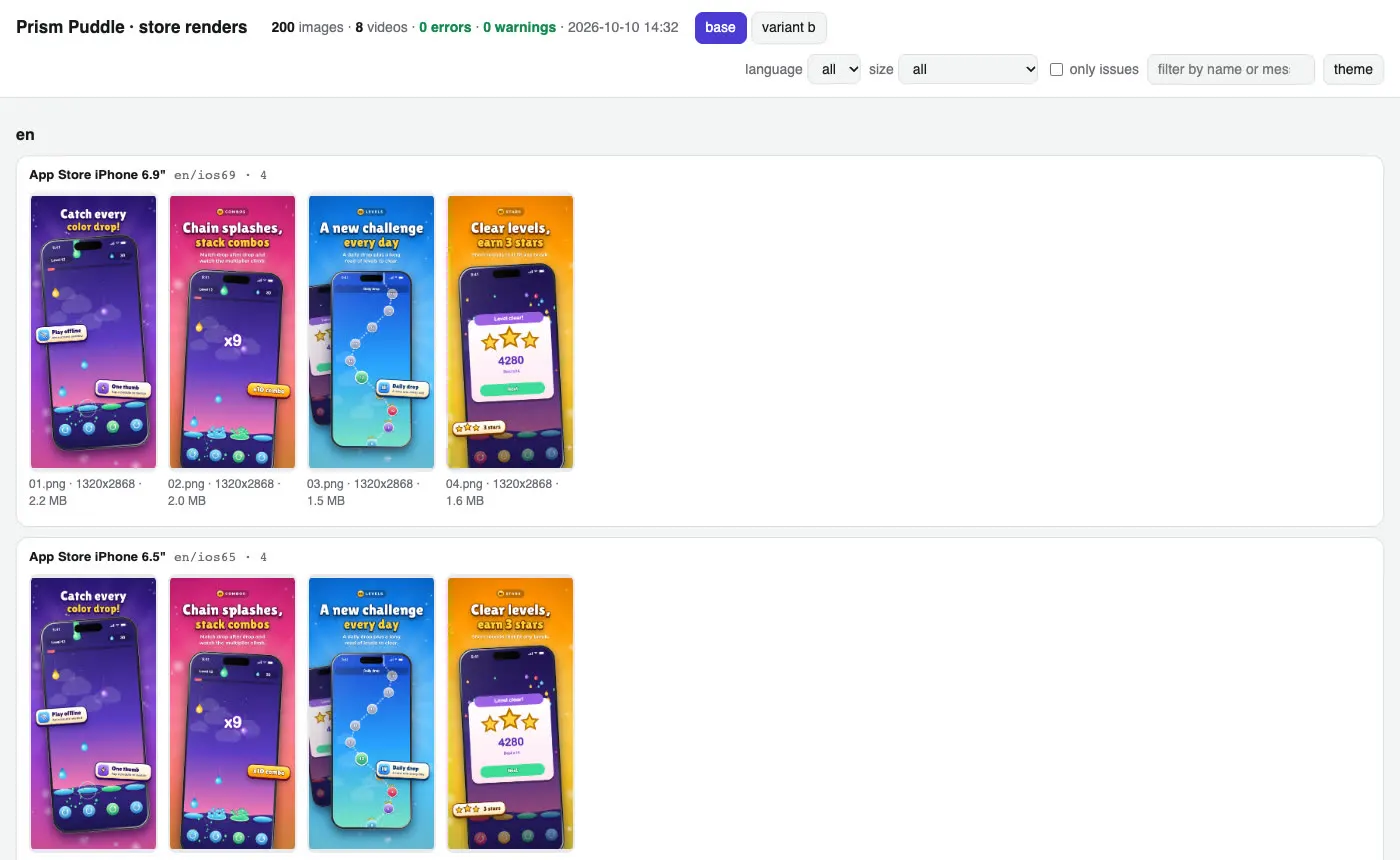
The review gallery: every language, size, scene and variant on one local page, store check issues highlighted
shots gallery: every language, size, scene and variant on one local page, store check issues outlined.
App preview, cut by shots video.
  • Capture from a web build (Playwright), the iOS Simulator, an Android emulator or a folder of your own frames.
  • Render iPhone 6.9" and 6.5", 13" iPad, Play phone, 7" and 10" tablets, the 1024 x 500 feature graphic. 24-bit RGB, no alpha.
  • Check the store rules locally with shots check; validate repeats it next to the store state.
  • Fonts subset to exactly your characters, so Japanese, Chinese, Korean, Arabic and Hindi just work.

After launch

The app is live. storebound keeps going.

Drafts and dry runs by default; anything that reaches users or money waits for your yes.

App StoreAPI

TestFlight

Beta groups, testers from a local CSV, builds to groups, What to Test in every language. Beta App Review stays your click.

apple testflight
Both storesAPI

Crash and ANR health

Play vitals against the bad-behaviour thresholds and App Store diagnostics, in validate and a weekly report.

health --weekly
Both storesAPI

Review replies

Your agent drafts replies to new reviews into local files. Only drafts you mark approved are sent, after a confirmation.

reviews draft
Both storesAPI

Prices from one CSV

Every product in every region at once. A diff table first, then your yes; App Store price changes can be dated.

prices import
Both storesAPI

Analytics snapshots

Installs, page views and conversion next to your listing changes and experiments. App Store through the API, Play from your monthly reports bucket.

analytics compare
App StoreAPI

Product page tests

A/B screenshot sets from your variants into App Store Product Page Optimization. Starting a test stays your click.

apple ppo

Quick start

Five minutes to a checked config.

1Add it to your app or game

cd my-app
bun add -d storebound playwright
bunx storebound init    # --profile app (default) | subscription-app | game
bunx storebound check   # offline: config, copy limits, Data safety, products, files

Credentials come from environment variables or the gitignored .storebound/credentials.json: a Play service account key and an App Store Connect API team key.

2Connect your AI tool

Claude Code

/plugin marketplace add https://git.crt.fyi/CRT/storebound.git
/plugin install storebound@crtkafa

Skills, MCP server and storebound on PATH. Or per project: bunx storebound install --agent claude

OpenAI Codex

bunx storebound install --agent codex

Skills in .agents/skills, MCP in .codex/config.toml (Codex reads it for trusted projects). The repo is also a Codex plugin, skills only.

Gemini CLI

gemini extensions install https://git.crt.fyi/CRT/storebound.git

Skills, MCP server and GEMINI.md. Or bunx storebound install --agent gemini

Cursor

bunx storebound install --agent cursor

Skills in .agents/skills and .cursor/mcp.json. The repo's .cursor/rules/storebound.mdc is an agent-requested rule you can copy.

VS Code / GitHub Copilot

bunx storebound install --agent copilot

Skills in .github/skills and .vscode/mcp.json.

Windsurf (Devin Desktop)

bunx storebound install --agent windsurf

Skills in .agents/skills, MCP in your global mcp_config.json.

OpenCode

bunx storebound install --agent opencode

Skills in .opencode/skills and opencode.json.

Anything that reads AGENTS.md

Copy or link AGENTS.md (rules and skill index) into your project and use the CLI. For an MCP client install does not know: command bunx with args ["storebound", "mcp"].

install takes several agents at once (--agent codex,cursor), --dry to preview, and only touches its own storebound entry and skill folders. Re-running it is safe.

3Ask your agent

  • “take my app to Google Play and the App Store”
  • “fill in the store questionnaires”
  • “add a yearly subscription with a free trial on both stores”
  • “the reviewer could not sign in”
  • “make store screenshots in 5 languages”
  • “is my app ready to submit”

The matching skill takes over. No AI tool? The skills are Markdown checklists you can read yourself.

Safety model

Built to be handed to an agent.

  • Credentials stay out of the repo

    Env vars or the gitignored .storebound/credentials.json. Official store APIs only, with keys you create and can revoke, never your password.

  • Dry run everywhere

    Every write command takes --dry; every MCP write tool has dry_run, default true.

  • Nothing public or irreversible through an agent

    Submitting, releasing, production releases, resuming or completing a rollout, canceling a submission, deleting and creating offer codes are not MCP tools. Demo accounts for reviewers live only in .storebound/. They stay terminal commands that ask first.

  • Idempotent writes

    Re-running converges (MD5 checks for screenshots and previews, one Play edit per language), so a failed upload is fixed by running it again.

  • Careful with your devices

    storebound shuts down only a simulator it booted itself, and never boots, wipes or reboots an Android emulator or device.